

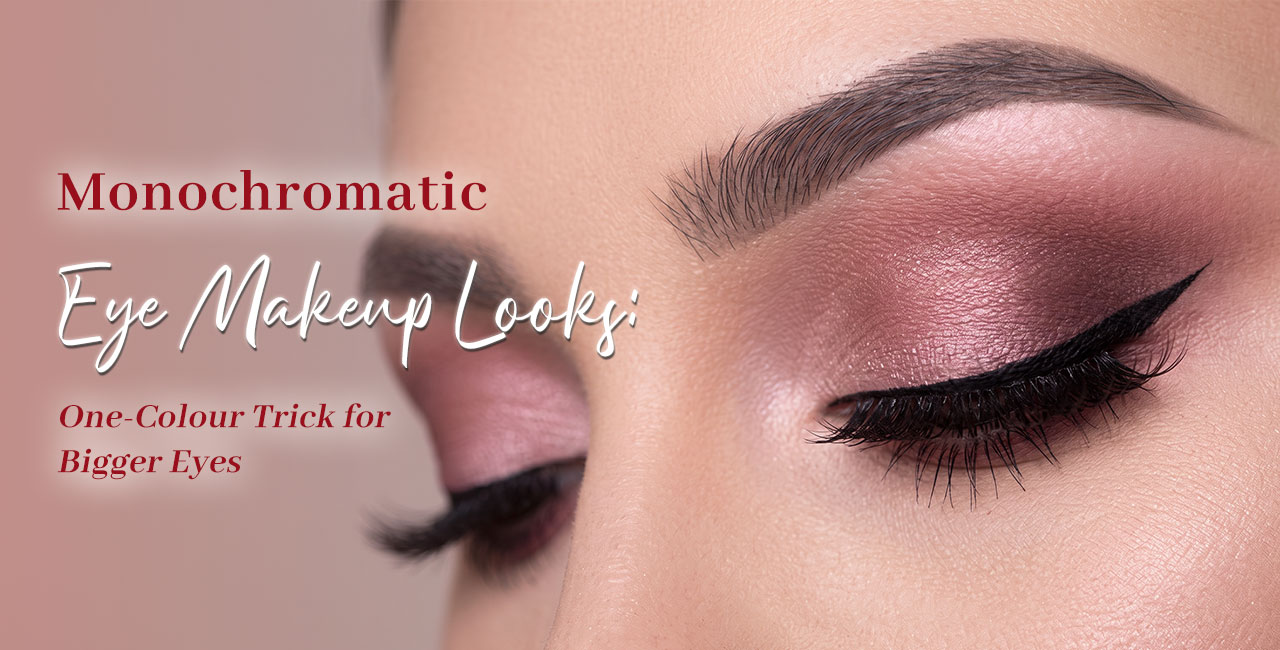
Monochromatic Eye Makeup Looks: One-Colour Trick for Bigger Eyes
A student came to us recently, frustrated that her eye makeup kept looking muddy despite using good products. The issue became clear within minutes of watching her routine: she was working with four unrelated colours on one eyelid — a cool taupe, a warm bronze, a purple in the crease for “depth,” and a black liner trying to hold it all together. None of these shades had any real relationship to one another. This is precisely the problem monochromatic eye makeup looks are designed to solve, and it’s one of the most reliable fixes we recommend to students at the Makeup Studio Academy.
The principle is simple: choose one colour family and use its shades in varying intensities, starting with the lightest shade at the brow bone and gradually moving to deeper shades towards the lash line. There’s no need to coordinate multiple unrelated shades or second-guess whether one colour will clash with another. A single hue, worked from light to dark, does the job on its own.
What Are Monochromatic Eye Makeup Looks?
Monochromatic eye makeup looks are built entirely around one colour family, applied at different intensities across the eye — and often extended to the cheeks and lips for a fully coordinated finish. Rather than pairing a brown eyeshadow with an unrelated pink blush and a red lipstick, the approach is to select a single colour, such as terracotta, and let it appear throughout the look in varying depths: a pale wash on the lid, a richer tone through the crease, a matching warm blush, and perhaps a brick-toned lip.
The term itself is quite self-explanatory: “mono” means one, while “chroma” means colour. On the eyes, this usually means using a lighter shade around the inner corner and brow bone, a mid-tone through the crease to create definition, and the most saturated version of that same colour on the lid.
Despite its current popularity on social media, this is not a new trend. Editorial makeup artists have been using single-colour eye looks for years, largely because the technique works consistently under studio and event lighting. Since every shade comes from the same colour family, there is little risk of colours clashing. The variation comes from the intensity, not from using different colours.
Why the Technique Works So Well
There is a practical reason monochromatic makeup looks tend to hold up better than multi-shade approaches, particularly for those newer to makeup application: fewer colours mean fewer opportunities for the blend to go wrong.
When every shade used belongs to the same colour family, each transition blends naturally into the next. There is no risk of a muddy, greyish patch forming where a warm brown meets a cool taupe, because the shades were never in conflict to begin with. The result is an eye that reads as one cohesive shape rather than a series of disconnected colours — which is exactly why this technique is favoured for bridal trials and photography, where makeup needs to remain clean and well-defined under demanding lighting for extended periods.
Skin tone is also an important factor to consider, especially for our students and clients. Warm shades such as copper, terracotta, and warm brown tend to complement a wide range of Indian skin tones because their undertones naturally work well with the warmth already present in the skin. Instead of trying to change or correct the complexion, these shades enhance its natural warmth and create a more balanced, harmonious makeup look.
How to Create a Monochromatic Eye Makeup Look?
This is the method we teach in our sessions. It works equally well with a beginner palette or a professional one because the technique matters more than the product.
Start by choosing your colour family before opening the palette. Rust, mauve, olive, and soft pink are all good starting options, depending on the occasion. Deciding on the colour first makes it easier to build the look without worrying about which shades will work well together.
Before applying any eyeshadow, prime the eyelid properly. This helps prevent creasing and keeps the gradient smooth and clean throughout the day.
Begin with the lightest shade, applying it from the lash line up to the brow bone to create an even base. Next, apply the mid-tone shade through the crease. Use a fluffy brush and work it back and forth gently. This step plays the biggest role in creating the shape and definition of the eye.
Keep the deepest shade focused on the lid. A dense, flat brush works best for this step. Instead of sweeping the colour across the lid, gently press it into the skin. This helps maintain strong pigmentation and prevents the colour from looking patchy.
Blend only where the shades meet rather than blending the entire eye. Over-blending is one of the most common mistakes because it can reduce the colour intensity you have built instead of simply softening the transition.
Finish with a thin liner in the same colour family, or use black for stronger definition. To make the entire makeup look feel cohesive, carry the same colour tone into the blush and lip shade as well. This final touch is often what makes a monochromatic look feel intentional and polished rather than simply looking like one colour has been used on the eyes.
Monochromatic Eye Makeup Looks for Different Occasions
The technique is versatile, and the same method can produce noticeably different results depending on intensity and shade selection.
For daytime or professional settings, muted tones work best — soft taupe, dusty rose, or warm beige, with the deepest shade limited to the outer corner rather than the full lid.
For evening or festive occasions, bolder shades such as copper, deep plum, or emerald are appropriate, with a touch of shimmer at the centre of the lid to catch the light.
Bridal makeup is where this technique performs particularly well. Warm golds, soft terracottas, and rose-browns photograph cleanly and complement rather than compete with the rest of a bridal look. For those training toward professional bridal work, this is a technique worth mastering early, as it comes up frequently in trials.
For a simpler, everyday version, a light wash of one neutral shade blended with a fingertip still qualifies as monochromatic and can be completed in a couple of minutes.
Common Mistakes to Avoid
A few common errors frequently occur among students and clients new to this technique.
Mixing shades that are close on the colour wheel but not truly part of the same family — brown and orange, for instance — technically breaks the monochromatic effect, even if the difference seems subtle.
Skipping the mid-tone and moving directly from a very light lid to a very dark crease often produces the harsh, unblended line this technique is meant to avoid.
Over-blending, to the point of removing the pigment rather than softening its edges, is one of the most frequent issues we see. The goal is to soften a transition, not erase the colour.
Ignoring the skin’s undertone can also affect the final result. For example, a cool-toned lilac may look washed out on very warm skin unless it is balanced with a warmer bronzer or lip shade.
For a comparison with other eye makeup techniques, our guide on how to do smokey eye makeup covers an approach that relies on deliberate contrast and a combination of different shades rather than working within a single colour family. Our piece on doe eye makeup is also worth reading if you’d like to pair a monochromatic palette with a more eye-opening shape.
Final Thought
Monochromatic eye makeup looks reward precision and a considered colour choice over the number of products used. For those looking to practise this technique with professional guidance, it is covered as part of our Comprehensive Make-Up Artistry course, as well as our shorter Certificate in Bridal Artistry. You can explore all our programmes on the Makeup Studio Training Centre, or read more technique guides on our blog page. If you have a specific look you’d like guidance on, get in touch and our team will be happy to help.
Frequently Asked Questions
Is monochromatic makeup the same as monochromatic eye makeup?
Not quite. Monochromatic makeup refers to the whole-face application of one colour family across the eyes, cheeks, and lips. Monochromatic eye makeup refers specifically to the eye portion of that look, and is often the starting point for the full application.
What are the most popular monochromatic eye makeup looks currently?
Terracotta and copper are the most requested shades among our students and clients at present. Soft rose-brown is popular for daytime looks, while deep plum is more commonly requested for evening or festive occasions.
Which colour is best for beginners to start with?
Warm brown or terracotta are generally the most forgiving options. Both are available in a wide range of shades within most palettes and suit a broad range of skin tones.
Does this technique work for hooded or smaller eyes?
Yes, and it often performs better on these eye shapes. Without a harsh colour contrast drawing attention to the crease, the eye tends to read as more open rather than closed off, which can be a concern with other techniques.
Is a special palette required for this look?
No. Most eyeshadow palettes already contain three or four shades within the same colour family; the technique involves identifying and using those shades together.
How does this differ from a smokey eye?
A smokey eye typically relies on dark, often cool-toned shadows blended for intensity and does not need to remain within a single colour family. A monochromatic look can be soft or bold, but always stays within one hue.

Sorry, the comment form is closed at this time.